On 12th January, 2026, the Bank of Ghana Governor – Dr. Johnson Pandit Asiama together with some Seven (7) officials of the Bank appeared at Parliament Public Account Committee Hearing to respond to monetary matters or some fiscal issues concerning the 2024 Auditor General’s Report compared to 2025 (yet to be released), as well as to give solutions on deficiencies that occurred. The seven members who accompanied the Governor include: Dr. Zakari Mumuni (First-Deputy Governor), Charles Elias Reindolf (Director of Audits), Naa Ayele Akrofi Osowa (Head of Treasury Markets under the Financial Department), Ellen Gyamera (Head of Petroleum Funds), Nii Sowah Awulu (Financial Market Department), Dr. Philip Abradu-Otoo (Director for Research Department) and Richard Assan (Acting Head of Banking Department).
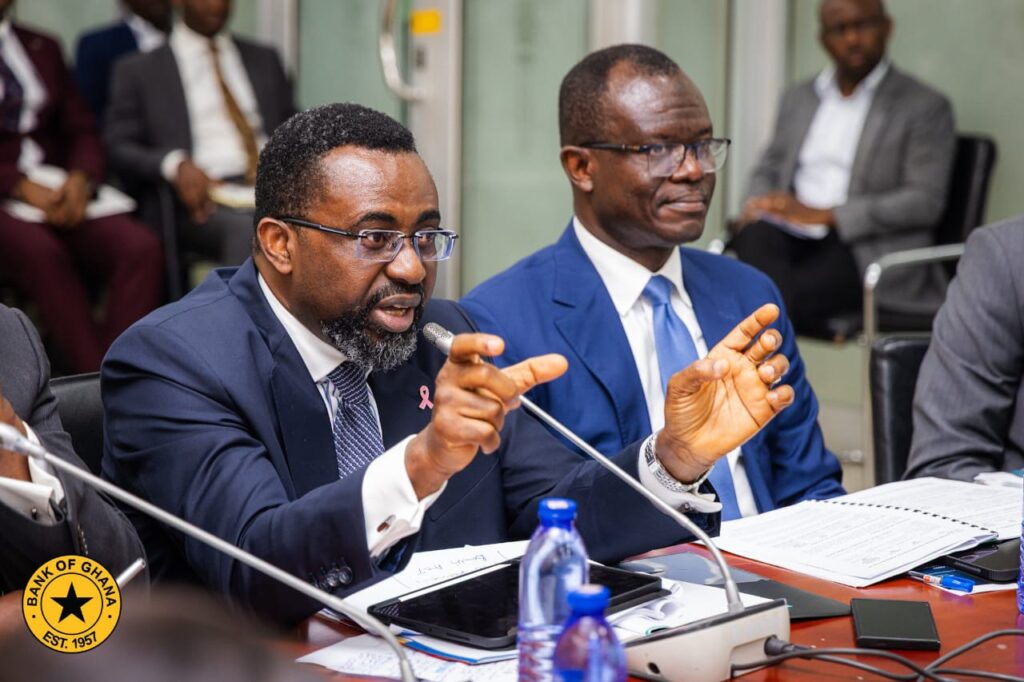
To begin with, Honorable Abena Osei-Asare, Chairperson for the Committee asked Dr. Johnson Asiama on the quantum of USD 6.1billion dollars that was surrounded to Bank of Ghana in terms of Cocoa and Minerals in 2024 and as to whether there has been any improvement or depreciation in 2025? Dr. Asiama in response to this question said that, these numbers are yet to be audited. Therefore, he will give accurate response or clarity on that after the completion of the exercise.
Abena further asked the Governor to give an idea on how proceeds from oil fed in 2025 compared to 2024. In response to this as well, the Governor asked Ellen Gyamera to reply and she addressed that, Petroleum revenue receipts for 2025 was USD770.27 million, and the “AFAR COMPONENT” (acronym used in oil and gas industry) was USD433.29million but these figures are yet to be audited, she added. Hon. Abena then asked that in 2024, the AFAR COMPONENT was USD 495million, so what accounted for its depreciation in 2025? The Governor then also replied that, generally this depreciation comes with prices and volumes on the foreign exchange markets but further details can be provided on that for further clarity.
Hon. Abena Osei again mentioned that the foreign exchange receipt for 2024 was USD11.9billion; consequently, can the Governor give fair estimation of whether there will be an increase or decrease of this figure result for the 2025 receipt? Dr. Johnson Asiama explained to her that, as a matter of fact, the external sector position generally had improved in 2025 and commodity prices have also really fed well last year but full clarity of these figures will be provided, when Auditing is completed.
On the part of work reports with respect to payments services and work projections, Hon. Abena asked the Dr. Asiama to provide clarity to the public on where his mandate lies as the Head of Bank of Ghana; in terms of whether he has the authority to check projects completion before issuing payments or whether Bank of Ghana collects details and issues payments due to instructions from Controller and Accountant General? Dr. Asiama gleefully responded that the Bank of Ghana being the Central Bank, is the Banker for Government and Government Agencies who adhere and depend on Controller and Accountant General’s (CAG) instructions based on these government agencies accounts in all cases, and that, payments are only effected through CAG. This is because, CAG is also the one in charge of operating these government agencies’ accounts, he added. A scenario was then given by a member of the committee that, an instance where payments are made on a project, yet the project hasn’t been completed, who is to be blamed? Dr. Asiama then replied that, the Central Bank only aligns with the documentation provided by CAG and therefore in such instance, it is the CAG and Ministry of finance who are to answer the Value for these monetary checks. Meanwhile, if a loan was taken from Bank of Ghana to undertake a project, but failed to meet the requirements, Bank of Ghana then solely bears the cost that were associated with that loan.
Again, the Governor was asked on what goes into Bank of Ghana Management and Technical Service fees; which Naa answered that, what goes into management and technical services under Bank of Ghana has to do with salaries of consultancy, services of a technical nature like payments of software services (Bloomberg, Reuters, etcetera), payments for technical assistance regarding the presidential Air force plane and payments for other engagements on official speeches and lectures. Abena then requested for official breakdown to be sent to the committee, since, there has been 18.3% increment compared to 2024’s own.
Issues Surrounding Commercial Banks
Hon. Abena informed that, there have been issues of unearned salaries allocated to some set of people and public officials be it in the Ministry of Education, Ministry of Health or any other government agencies. In which complaints are that, these people who have resigned or no more working with these institutions are still mistakenly been paid their salaries through the Banks, as a result of the numerous staff these government agencies have. The Commercial Banks who have records and accounts of these people on the other hand, are also finding it difficult to release payments back to CAG; and they either delay or play refusal even when there is an evidence of proof on that. Therefore, Abena appealed to the Governor going forward, to provide measures or support that can assist CAG to retrieve all error payments made to these Banks.
Furthermore, the report also focused on questions on various Commercial Bank Dealers and their schedule of earnings. According to Hon. Abena, some of the commercial banks have low receipts but are able to operate huge quantum of money in terms of transactional transfers and therefore, requested to know how these Banks are operating. That is, whether Bank of Ghana supervises their receipts that come in or whether they are been sponsored by Bank of Ghana itself. In other words, she asked whether if Bank of Ghana have been the one feeding these Banks with those huge differences of money in terms of Foreign Exchange? With this, Dr. Asiama replied that, there is an Inter-Bank Foreign Exchange Market under Bank of Ghana, so if a Bank has a demand from a client for some transfers to be made, they are supported with relevant documentation, which Bank of Ghana regulates it by doing background checks on site to examine the authenticity of that document before those transactions are finally done. Also, he added that CEOs of Commercial Banks have been advised to promote more of Ghana’s Export, and Bank of Ghana currently, has been critically monitoring these Banks to ensure that they are not only doing Banking but internationally understanding other countries markets to help the Ghanaian firms as well.
From the report, policy decision that aroused the increment of 48.6% on foreign exchange in 2025 were informed to have also been as a result of the sundry and non-surrounded payment. Again, regarding IMF (International Monetary Funds) structural benchmarks, the Governor informed that the structural benchmarks related to Bank of Ghana are really satisfying because, the most recent review on these structural benchmarks with IMF had no queries. But with the progresses made in 2025, it is solely the responsibility of Ghana Revenue Authority, Ministry of Finance and CAG to give specific details and clarities on that.
Matters Surrounding Gold for Reserve and Gold for Oil Programs
In addressing the Committee, Dr. Asiama said these programs that started in 2021 to meet specific issues, government have made some provisions last year May, for its refinement leading to cancelation of some other aspects like the Gold for Oil and currently, there is only the G for R that is – Gold for Reserve Program. Which he said that, Bank of Ghana has also authorized an External Audit to inspect this G for R from its starting date through to the end of 2024 and how it has operated during 2025 as well. These Audits reports will be provided to the committee for further discussions, he added.
He then suggested that, the program also needs reforms in order to reduce further costs that are associated with it, as well as it being treated as quasi-fiscal interventions to support relevant and pressing national issues, as outlined. Naa on the other hand in responding to the Committees questions on the report, also informed that as at 25th December, 2025, Bank of Ghana’s asset position under the G for R, stood at USD13.829 million and the Governor also shared some losses incurred between the G for O and G for R in the period of 2022 to 2024. They are:
- In 2022, net losses for the Gold for Oil, was about GHS74.44million whilst Gold for Reserves had no losses.
- In 2023, net losses for Gold for oil, was GHS317.69million whilst net loss for Gold for Reserves was also GHS 1,000,000,054.84
- In 2024, net losses for Gold for Oil, was GHS1.8billion whilst Gold for Reserves was GHS3.8billion. But at the moment, 2025 financial data are under Audit and will be published in March, he informed.
The governor then added that these programs assigned to meet national challenges indeed, needs reforms as ascertained, to make it efficient and effective and to sharpen and support economic stabilization for the country. Bank of Ghana Board for instance, is having a joint meeting this week with Gold Board and other stakeholders to ensure that this Gold for Reserve gains accurate grounds to meet its demands, he announced.
Again, even though, the losses incurred on Gold for Reserve was higher compared to Gold for oil, that is – GHS3.8billion and GHS1.8billion respectively, Bank of Ghana board called for Gold for Oil cancelation because, tantrums surrounding it was numerous, disturbing and needed to be dismissed to prevent its further disorganization. Whilst, with the Gold for Reserves it wasn’t canceled because, its data evidence showed improvement and enhancement in its efficiency, he clarified.
Apart from that, Hon. Abena, the Chairperson for the committee said that currently, inflation rate is around 5.4%, so, what is Bank of Ghana’s target of inflation rate as far as its monetary policy transmissions and credit conditions are concerned? In response, Dr. Asiama said that, Bank of Ghana has a medium term target of 8±2% as their inflation rate target and therefore, that hasn’t been changed but will keep ensuring that, inflation drops to the minimum level to satisfy every Ghanaian. But on the aspect of inflation not affecting businesses and household in terms of loan taking, the Governor defended that, the data suggested otherwise, and that, during their Monetary Policy Committee (MPC) meeting recently in November on credit conditions, reports revealed that, average lending rate (Loan taking) had declined at 22.2% compared to 30.5% last year. As a matter of fact, the Governor alluded that the deflation experience in terms of goods and services had caused the decline in Loan taking, and that, even Ghana Reference Rate (GRR) has also sharply reduced to about 15%.
Finally, the Governor encouraged that, Bank of Ghana isn’t only using their interest rate as a traditional tool but are also engaging with stakeholders and the Commercial Banks to support the real sectors in export activities, to recover new markets. As well as to help the Ghanaian Business man to also discover opportunities internationally from outside Banks like Nigeria, South Africa and many more to boost his businesses.